Recoveries, settled vs broken possession, and halves as a process split — not a fatigue table. Do not write a story event data cannot support.
Skills you will practice
Sample lesson titles
Reading transitions carefully
12 min
A recovery is a new possession after the opponent had the ball. A loss ends that possession. This layer is the Transitions Board — not a fitness ranking.
A recovery starts a new possession after the opponent had the ball — this layer is the Transitions Board, not a fitness ranking.
How to read this: Name the possession change, a time window, and whether the next action progressed or shot. A short post-recovery window is a conservative stand-in, not a full transition model.
Name the possession change, a time window, and whether the next action progressed or shot. Progressive Pass counts and short post-recovery windows are conservative stand-ins.
Event logs cannot invent rest-defence shape or fatigue. Quote the definition. Do not upgrade a transition count into a moral story.
Stable possession vs fragile possession
11 min
Stable possession means keeping the ball without immediate pressure. Fragile possession ends quickly. Possession share is not a quality verdict.
Stable possession keeps the ball without immediate pressure; fragile possession ends quickly — possession share alone is not a quality verdict.
How to read this: Proxy stability with sequence volume, progression, and what follows losses, under a named definition, not by possession percentage alone.
Proxy stability with sequence volume, progression, and what follows losses under a named definition. Compare halves when the sample allows it.
Those proxies do not prove coach intent or off-ball cover. If volume and chance quality disagree, write the disagreement.
First half vs second half as process, not fatigue
11 min
A half table splits the same process. Event data has no distance run. This table is not fatigue.
A half table splits the same process by time — event data has no distance run, so this is not a fatigue measurement.
How to read this: Compare shots, xG, and progression half by half. Score state and substitutions can move the split as much as fitness would.
Compare shots, xG, and progression half by half. Score state, substitutions, and sample noise can move the split.
Do not invent tired legs from event logs. A second-half drop in Progressive Pass volume may be game state, not GPS fatigue.
Reading state-of-game changes carefully
11 min
Score state is an allowed hypothesis. It is not proof of fatigue or coach intent. Read state changes with the process, not instead of it.
Score state is an allowed hypothesis, not proof of fatigue or coach intent — read state changes with the process, not instead of it.
How to read this: A lead, a chase, or a red card can move the metrics the file records. Name the state window and pair it with the process, rather than folding a late chase into a season identity.
Lead, chase, and red card can move metrics the file records. Keep shoot-outs out of open-play process totals.
Name the state window. Pair it with the Transitions Board or half split when useful. Do not fold a late chase into a season identity.
Event data records what happened on the ball. It does not show where every player stood.
How to read this: Left: the scattered event points. Right: a dashed line standing in for tracking, which these files do not contain. Do not draw that path from guesswork.
xG estimates how good a shot was. It does not decide who won.
How to read this: Ten equal circles are ten similar shots at about 0.30. In the historical sample, roughly three of those ten are goals. In one match that three may arrive, or not.
Equal dots show location only. Chance quality needs an xG (or similar) encoding.
How to read this: Left: three equal markers. Right: the same locations sized by quality. A distant shot is no longer equal to a tap-in.
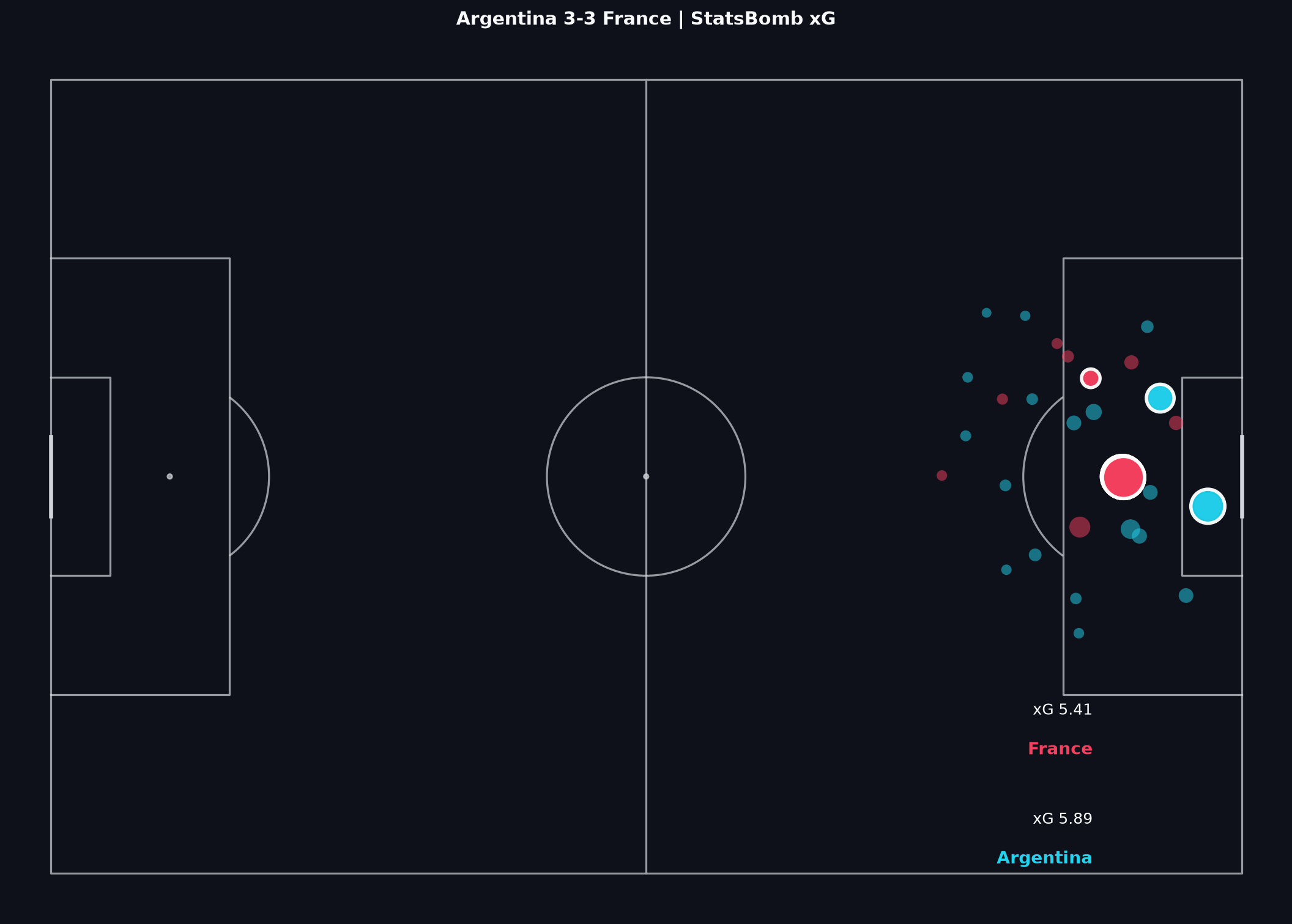
From Match Analysis: Argentina–France shot map
Match Lab Shot Maps encode more than location. Read volume with quality and phase.
How to read this: This is the Argentina–France teaching Shot Map from Match Analysis. Count dots only after you know how markers encode quality and phase.
A pass network is a graph of players and completed-pass links — not a tracking picture of off-ball positioning.
How to read this: Thicker edges mean more frequent completed links between two average locations. Thin edges can mean isolation, a small sample, or a score-state shift.
A progressive pass is a completed pass that gains stated ground toward the opponent goal. Volume and share are different questions.
How to read this: Normalise attack direction first. This layer is not the Transition board and not a tracking carry map.
PPDA is a press-intensity proxy. It is not a fitness ranking and not a quality score for the press.
How to read this: A lower rate means more defensive actions relative to opponent passes in the named zone. Compactness, distance run, and coordination still need video.
A heatmap counts on-ball events in pitch cells. It is not a tracking picture of off-ball standing, and not a proof of formation.
How to read this: Hotter zones mean more recorded on-ball actions there. Average position is one summary point of those actions — not continuous location without the ball.
A supportable report keeps three voices separate: observation, inference, and recommendation.
How to read this: Observation states what the file shows. Inference states what it might mean. Recommendation states what to try next. Mixing them overstates certainty.
One scoreline is not proof of the process, and one process number is not proof of the scoreline.
How to read this: A single highlighted match can sit anywhere in a wider spread. Name the sample size before treating one point as the pattern.
Connect two numbers only when they answer the same question — if they disagree, write the disagreement.
How to read this: Progressive passes, a shot cluster, and a PPDA shift can converge on one timed question. Forcing metrics that answer different questions into one story is decoration, not evidence.
A capstone brief separates the pre-match question from the post-match supported sentences — the scoreline is not the report.
How to read this: Layer shot quality, progressive patterns, a pressing proxy, and spatial summaries, each with a named definition, then keep observation, inference, and recommendation apart.
Quality means every claim names its sample and its limit — a higher bar is more supported sentences, not a harsher verdict.
How to read this: Move from an unsupported claim toward a claim that names its sample size and states its limit. That shift is what raises the bar, not stronger language.
xG starts once a shot exists — possession value asks about the threatening buildup before the attempt.
How to read this: The left dot is a single shot's xG. The right chain is value added across the possession that led there, even when it never produces a shot.
xT estimates threat from location and action — not a finish model and not a verdict on the result.
How to read this: Zones closer to goal carry higher scoring likelihood historically. A pass into a brighter zone can raise xT; a backward pass can lose it.
Shot value asks how good the finish chance was; action value asks whether an earlier choice moved the ball into a more dangerous state.
How to read this: A blocked cross can carry action value with zero shot value. Treat 'no shot' as not the same as 'no process.'
A possession-value lead is not a moral win — single-match sums are noisy, and conversion still happens at the shot.
How to read this: Value can climb through several progressive actions and still end without a shot. Quote both the value trend and the shot outcome; do not let one replace the other.
A recovery starts a new possession after the opponent had the ball — this layer is the Transitions Board, not a fitness ranking.
How to read this: Name the possession change, a time window, and whether the next action progressed or shot. A short post-recovery window is a conservative stand-in, not a full transition model.
Stable possession keeps the ball without immediate pressure; fragile possession ends quickly — possession share alone is not a quality verdict.
How to read this: Proxy stability with sequence volume, progression, and what follows losses, under a named definition, not by possession percentage alone.
A half table splits the same process by time — event data has no distance run, so this is not a fatigue measurement.
How to read this: Compare shots, xG, and progression half by half. Score state and substitutions can move the split as much as fitness would.
Score state is an allowed hypothesis, not proof of fatigue or coach intent — read state changes with the process, not instead of it.
How to read this: A lead, a chase, or a red card can move the metrics the file records. Name the state window and pair it with the process, rather than folding a late chase into a season identity.